Revolution in a Chinese Village - Ten Mile Inn by Isabel Crook & David Crook
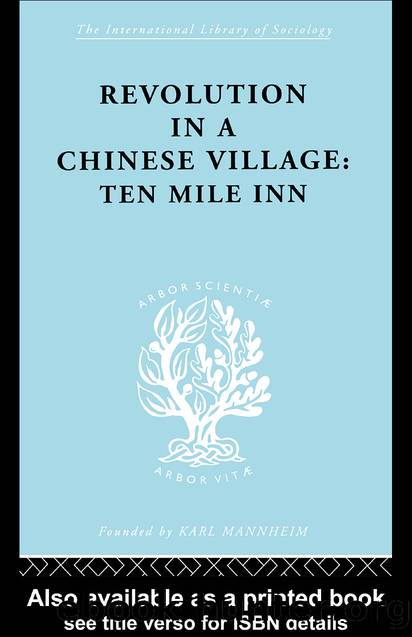
Author:Isabel Crook & David Crook
Language: eng
Format: epub
ISBN: 0203000986
Published: 1959-02-15T00:00:00+00:00
Chapter 7
Ten Mile Inn Under Its First Elected Government
A short time after the cleaning up of the Ten Mile Inn Party branch, Wang Tse-yin, who had been appointed village head, was promoted to a post in the sub-county administration. To choose his successor, and at the same time to establish a new village government, Ten Mile Inn began to prepare for its first democratic elections.
The Bean Elections
To overcome the problem of illiteracy, the âbean methodâ was used. The candidates sat in a row, each with a bowl behind him. Every voter, which meant every man and woman eighteen years of age and over, was given seven beans to place in the bowls of the seven candidates whom he or she wished to form the village government. This method had the advantage of enabling the illiterate voter to be sure he was voting for the man of his choice. The candidates themselves, on the other hand, could not see who was or was not voting for them and so could bear no grudges.
Even this device for securing a fair democratic vote had some weaknesses. When a few years later a better method was introduced, one peasant, in explaining the new improvements, said:
âWith the bean method some people who didnât have any particular preference just dropped their seven beans in the bowls in order. So the first seven candidates in the row always had an advantage over the rest. On the other hand, some people who had very strong preferences, cheated by dropping several beans into the bowls of their favourite candidates.â
Despite such drawbacks as these, the âbean electionsâ were, generally speaking, fair and democratic.
The result of the first of them was that a former brick-maker and new middle peasant named Wang Hsi-tâang became village head of Ten Mile Inn.
One of the first tasks which the new village head was called upon to carry out was to shoulder the traditional responsibility of village government â that of collecting taxes. Under Wang Hsi-tâangâs guidance, despite the continuance of all sorts of evasion tactics by the wealthy, the new tax system continued to work out far more fairly than that of the past. The village officials, though lacking experience in the ways of high finance, proved quite capable of applying the tax-table issued by the Border Region Government. In one case at least they improved upon it. A certain exemption was officially granted to cover the cost of one bushel of fertilizer for every mu of land a family owned. The new cadres, thoroughly imbued with the principle of progressive taxation, decided that this allowance ought to be in accordance with the quality of the land; also that the distance of the fields from the village ought to be taken into account. These modifications were later adopted by the county authorities.
Perhaps as a result of adopting too many such suggestions, the 1944 table was âa great thick volume in red and black print, so complicated that none of us could understand it!â In fact,
Download
This site does not store any files on its server. We only index and link to content provided by other sites. Please contact the content providers to delete copyright contents if any and email us, we'll remove relevant links or contents immediately.
| Anthropology | Archaeology |
| Philosophy | Politics & Government |
| Social Sciences | Sociology |
| Women's Studies |
Cecilia; Or, Memoirs of an Heiress — Volume 1 by Fanny Burney(32558)
The Great Music City by Andrea Baker(32019)
Cecilia; Or, Memoirs of an Heiress — Volume 2 by Fanny Burney(31956)
Cecilia; Or, Memoirs of an Heiress — Volume 3 by Fanny Burney(31942)
We're Going to Need More Wine by Gabrielle Union(19046)
All the Missing Girls by Megan Miranda(16029)
Pimp by Iceberg Slim(14508)
For the Love of Europe by Rick Steves(14121)
Bombshells: Glamour Girls of a Lifetime by Sullivan Steve(14076)
Talking to Strangers by Malcolm Gladwell(13370)
Norse Mythology by Gaiman Neil(13365)
Fifty Shades Freed by E L James(13241)
Mindhunter: Inside the FBI's Elite Serial Crime Unit by John E. Douglas & Mark Olshaker(9343)
Crazy Rich Asians by Kevin Kwan(9292)
The Lost Art of Listening by Michael P. Nichols(7506)
Enlightenment Now: The Case for Reason, Science, Humanism, and Progress by Steven Pinker(7313)
The Four Agreements by Don Miguel Ruiz(6765)
Bad Blood by John Carreyrou(6622)
Weapons of Math Destruction by Cathy O'Neil(6281)
